1–A overview
Solander 38
A self-sufficient, solar-electric, coastal cruising power catamaran.
Published

I live in British Columbia’s Gulf Islands, a lightly-populated archipelago halfway between the cities of Vancouver, BC and Victoria, BC, and just north of Canada’s ragged marine border with Washington state.
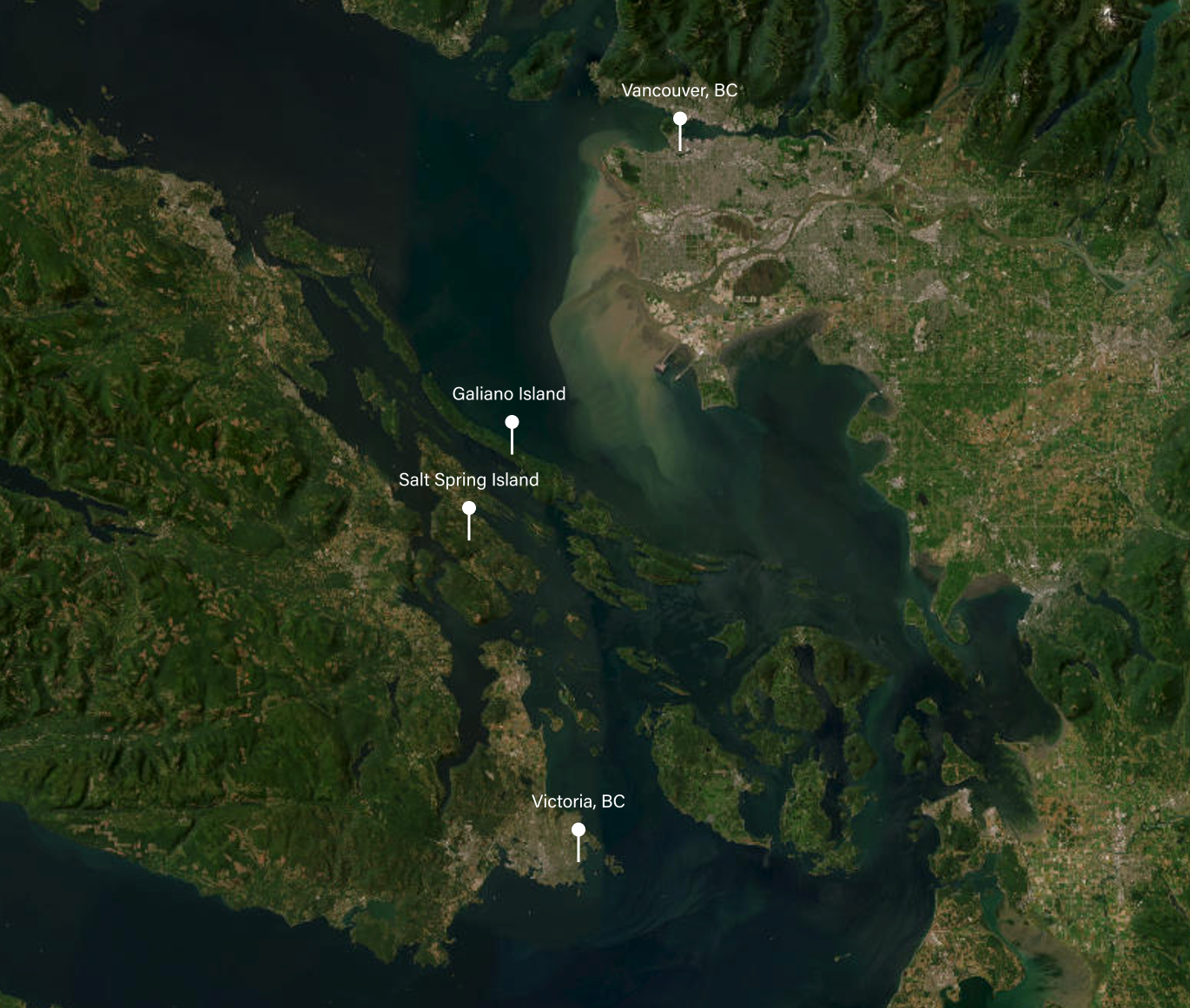
Living on these islands is ideal for people who love forests, beaches, oceans, and logistical inconvenience. My home is on Galiano Island, and on any given day, I can likely meet my needs with what’s available here on Galiano; but if I need a pharmacy, or a swimming pool, or fresh seafood, I need to travel by boat or ferry to another island. Even the services that are available on Galiano often depend on someone (a hairdresser; a dentist; an electrician; the cable guy; a lab technician) coming over the water for the day, weather permitting. And of course every business on the island is supplied by trucks full of goods or groceries or gasoline coming on ferries from the mainland every week.
A rarely acknowledged reality is that this creates a much larger than average carbon footprint compared to our friends in the city or even living rurally on the mainland. It’s all too easy to feel virtuous eating veggies from your garden in your passive-solar home in the woods without considering the vast quantities of diesel burned in ship engines to enable your idyllic lifestyle.
I started feeling this most personally and acutely when my kids got to the age where they left the tiny local school and started commuting to Salt Spring Island, our larger neighbour. The school district runs the marine equivalent of a school bus (the “Scholarship”), but of course kids rarely want to come home the instant the bell rings; they want to stick around for band practice, or the robotics team, or just to hang out with their friends from other islands. And when they finally do want to come home, they’re the wrong side of 10 miles of ocean.
So I’ve spent years shuttling my kids and their friends around on a lovely old Albin 25, with its marinized Kubota tractor engine thudding in my ears, my nostrils, and my climate conscience. I drive an electric car, and have for 15 years, but these days the car isn’t where I spend the most time behind the wheel. For a while, I considered converting that boat to electric, but although I could have kludged something together for the winter commutes, we had gotten hooked on taking it on longer trips in the summer, and the range math just didn’t work.
It’s also worth saying that the Albin 25 is a jewel of a design, for the strengths and limitations of a small diesel engine. Like anything well-designed, when you change one of the fundamental constraints, it becomes something much less. The same is true in the larger context: boat builders have a hundred years of tradition and experience in building power boats, and much much longer building for sail, but electricity has its own new challenges and opportunities, and the design language of boats hasn’t yet learned how best to work with them.
So, with the typical hubris of an engineer, I decided to build something new: a boat that met my particular idiosyncratic desires and applications. It had to work for short trips in the winter, and long trips in the summer; it couldn’t rely on dock-side charging infrastructure, because I don’t have that at home or any of the places I want to travel to; it had to comfortably accommodate my family of four, without being so heavy with luxury that it consumes too much power; and it should call back to the sailing and boating traditions of the Pacific Northwest without being afraid to be new and weird where that was justified.
From those broad strokes, physics started to fill in some finer detail. Electric power without shore infrastructure meant solar panels, clearly; the wind here is not consistent enough to rely on either sail or turbine. It had to be long enough to reach my accustomed cruising speed of 7 knots without too much effort, and wide enough to support a significant solar surface area, but narrow where it meets the waterline to avoid wave-making; and sit shallowly in the water to avoid too much drag and displacement. A performance sailing catamaran’s hulls would be a good start, but where to find them? That’s its own story…
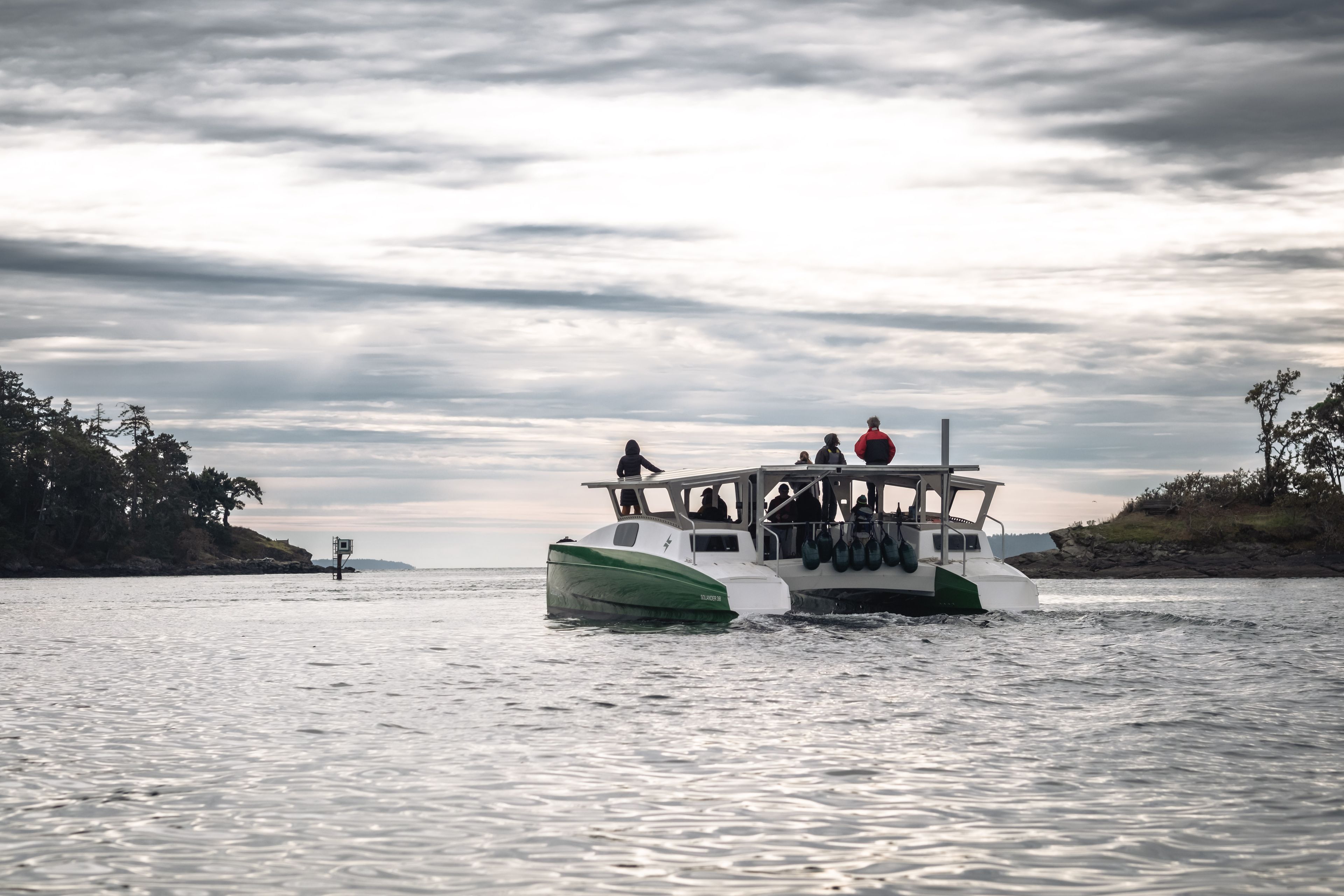
A very personal and particular project, in its origin. But in the end, very much the opposite. Building this boat involved an ensemble cast from Maine to Michigan to Oregon to the cornfields of Ohio, the boatyards of Port Townsend, WA and Sidney, BC, to right here on Galiano. We’ve built this site both to celebrate their work and to share their designs and stories — and ultimately to share the detailed results, whether successes or failures, of this experiment.
More than that, building this boat was the seed — the Catalyst — for the broader missions of the Rising Tide Research Foundation and Rising Tide Boat Works. I hope it makes my commutes a little quieter. But maybe — hopefully — it can also do a little bit more.